How to Use AI to Create and Release a Meaningful Music Catalog: My 265-Song Blueprint in 9 Months
Intro: 265 songs. 9 months. Why I started.
I started for two reasons.
First, I had just completed a public television documentary series a few months earlier, and I had not found another creative outlet to chase. That left a vacuum. I needed somewhere to put my energy.
Second, once I tried AI music software, I was blown away by what it could do. I was instantly hooked. I could see the potential immediately. I wanted to explore every kind of story and genre I had in me. Country. Hip hop. Western. Reflective songs. Story songs. Songs about family, struggle, regret, redemption, hometown identity, ambition, and collapse.
What AI gave me was not talent. It gave me access. It removed friction between the idea in my head and a finished song I could actually hear.
Over the next nine months, I built and released a solo catalog of more than 265 songs. That output did not happen because AI did the work for me. It happened because AI finally gave me a way to move at the speed of my own ideas.
Section 1: What AI actually did for me
AI made the process faster, broader, and more accessible.
It helped me distill raw thoughts into usable song concepts. I could take a mess of memories, themes, moods, and story fragments and turn them into something clear enough to build from. That was the first real advantage.
ChatGPT helped me find direction. It could help surface a title, a hook, a theme, or a sharper lyrical angle. It gave shape to rough material and made it easier to move from vague instinct to actual structure.
Then Suno changed the next part of the process. Instead of only imagining what a song might sound like, I could hear versions of it almost immediately. I could test genre, tempo, vocal tone, instrumentation, mood, and arrangement in real time.
That is what AI actually did for me. It accelerated ideation, drafting, experimentation, and output.
It did not create meaning. It shortened the distance between imagination and execution.
Section 2: What I still had to do myself
The real work was still human.
I had to decide what was worth keeping.
Even when AI gave me a strong starting point, I still had to rewrite weak lines, fix syllables, change phrasing, adjust section order, and tighten the structure until it matched what I actually wanted. AI could get me close. It could not finish the song for me at the level I expected.
The same was true once the music started generating. I still had to judge tone, pacing, emotional weight, vocal feel, and overall impact. I had to reject the versions that sounded competent but empty. I had to recognize when one finally connected.
That became the real skill inside the process.
Most people misunderstand AI music because they focus on whether the tool can generate good output. It can. The harder question is whether the person using it has the taste, patience, and emotional clarity to know which output is actually right.
At a certain point, many generations sound good. My job was to hear the one that felt true.
That was the difference between noise and a song I believed in.
Section 3: My end-to-end AI music workflow
My workflow was direct.
1. Start with the concept
I began with an idea, a memory, a phrase, an emotion, a scene, or a story I wanted to explore. Sometimes it was personal. Sometimes it was fictional. Sometimes it was just a mood or an angle I wanted to chase.
2. Use ChatGPT to refine the direction
I would write out paragraphs of thoughts and use ChatGPT to help find the center of the song. That might be a title, a hook, a theme, or a stronger structure. Then I would use it to help draft lyrics in the genre and style I wanted.
3. Rewrite until the lyric felt right
I did not just accept whatever came back. I rewrote constantly. I adjusted syllables, rhyme, phrasing, and section order until the lyric matched my vision.
4. Move into Suno
Once I had lyrics and direction I believed in, I moved into Suno. There I would input the lyrics and build prompts around:
• genre
• mood
• style
• tempo
• instruments
• vocal delivery
5. Generate repeatedly
I listened to every version critically. Then I adjusted. Then I generated again. This was where most of the refinement happened. I might change one line, add a bridge, simplify a verse, or alter the sonic instruction entirely. Then I would keep going until one version hit my ears the right way.
That cycle could happen 20 times. Sometimes 100.
6. Export and finish in SoundLab
Once ChatGPT and Suno delivered a version I liked, I imported the file into SoundLab, which functioned for me like a lightweight audio editor. My edits were simple but important. I usually raised the gain by about +2 and made sure the fade-out was correct.
That last part mattered more than people think. A bad fade can weaken the entire song. I cared about the ending sounding natural and complete.
7. Create the artwork
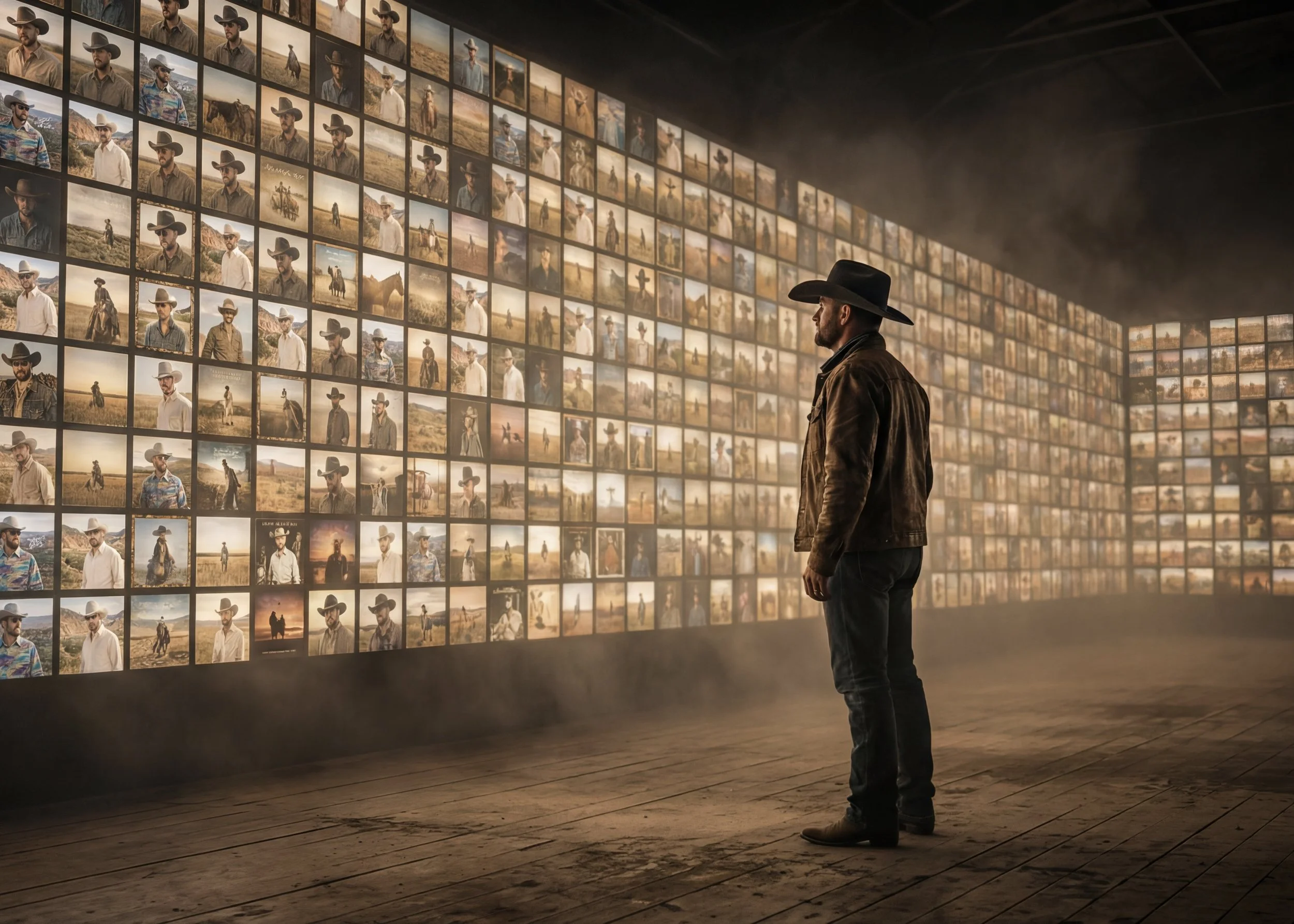
After the audio was finished, I moved to cover art. Whether it was for a single or an album, I usually used ChatGPT image tools with around 8 to 10 reference images of my face. I would brainstorm the scene, mood, framing, styling, and atmosphere, then work toward the visual I wanted.
That often included:
• a cowboy hat with a specific crease
• sunglasses
• Texas Panhandle landscape
• cinematic or moody tone
• square format for streaming platforms
After generating the base image, I moved it into Adobe Express and added my signature. The size, placement, and color of the signature had to fit the image itself. I wanted the artwork to feel finished, not stamped.
8. Distribute through DistroKid
Once the song and artwork were complete, I logged into DistroKid and uploaded the release. I selected the genre, set the release date, attached the artwork, and submitted it for distribution.
That was the system.
Concept. Lyrics. Rewrite. Generate. Refine. Edit. Artwork. Distribution.
Then repeat.
Section 4: What broke at scale
The music got better over time.
What started breaking after 250-plus songs was not the technical quality. It was the emotional supply.
After nine months and more than 50 projects, I had told nearly every story I could find access to. I had gone through memory, identity, pain, ambition, regret, redemption, family, faith, geography, struggle, and reinvention. I had mined myself hard.
That kind of output catches up to you.
I went from confident and eager to burned out faster than I expected. The volume raised my expectations. Every new project made me think the breakthrough was closer. I kept assuming the quality, pace, and scale would eventually force a bigger response.
It did not happen that way.
By the time I was around song 260 to 265, I was frustrated by the lack of support relative to the effort. My expectations kept rising while the feedback stayed low. I tried to solve that problem.
I submitted to playlists. I got placed on several. I ran Spotify campaigns on albums and singles. Some of those campaigns performed well. One song reached around 35,000 plays through promotion. For a while, it looked like momentum was building.
Then it slowed down.
At the same time, I was out of inspiration. I was burned out from creating. I was disappointed by the gap between effort and results.
So I shifted into AI video production for about a month. That became the new creative outlet. I made music videos, short films, promo videos, and supporting visuals tied to the music. But AI video was too expensive to sustain, and it was not being received at the level I hoped either.
That exposed another hard truth.
High output does not guarantee traction.
High quality does not guarantee support.
Constant production can inflate expectations past what reality will return.
Section 5: What I learned about quality, identity, and release strategy
I learned that I can operate at the level of several departments by myself.
In nine months, I created an entire catalog. I built an artist identity based on myself. I wrote, directed, refined, packaged, branded, and released music at a ferocious pace. I ran a one-man label with high output and high production standards.
That proved something important to me.
I do not lack discipline.
I do not lack ideas.
I do not lack taste.
I do not lack work ethic.
What I lacked was a sustainable relationship with the pace I had chosen.
I also learned that quality and quantity are not enemies, but they do create new problems when taken to an extreme. The more music I released, the harder it became for any one song to feel important. The catalog grew stronger while individual releases became easier to lose in the flood.
That changed how I think about release strategy.
Speed can help you build a body of work.
It can also flatten your impact.
A meaningful catalog is not just about making songs. It is about deciding which songs deserve space, time, and attention.
I proved I could build the machine.
Eventually I ran out of gas trying to feed it.
Section 6: Where I stand now
Now I am letting the catalog live.
The best songs continue to rise to the top. Even without showcases or paid playlist placements, the music is still being played. The numbers are lower than during active campaigns, but the catalog still brings in hundreds of plays a day from around the world.
I have listeners in Australia, Europe, South America, and North America.
That matters.
I have stepped back in a major way. In practical terms, I have mostly retired from the chase. It stopped feeling like a hobby and started feeling like a source of pressure. My expectations had become inflated by the amount of effort, volume, and perceived quality I was putting out.
Right now, I do not have more stories to tell.
So I am focused on real life. My family. My day job. The normal responsibilities that do not care about algorithms, releases, or creative ambition. Spring is here, and that means yard work, maintenance, and the ordinary structure of life.
The music is not going anywhere.
It lives on streaming platforms. It continues to be heard. It continues to generate income. I did not get the huge break I thought might come from this run, but I did build something durable. Over nine months, I created a catalog that can keep earning, keep reaching listeners, and keep existing long after I stepped back from the grind that built it.
That is worth something.
Conclusion: What AI music is good for, what it is not good for, and what creators still misunderstand
AI music is good for helping creative people find out who they are.
It is a powerful tool for writing from the heart, exploring your past and present, testing ideas about your future, and turning personal material into something you can actually hear back. In that sense, it can function like a diary, a journal, or a mirror with sound.
That is where a lot of its real value lives.
Hearing your own story come back through a high-quality song can be deeply clarifying. Over these nine months, I think the process helped me work through confusion, regret, ambition, trauma, identity, and unfinished emotions that had been sitting in me for years. It gave shape to things I had not fully processed. It helped me accept things I had been battling internally for a long time.
It also helped me build a world of music faster than would have been possible otherwise.
What AI music is not good for is replacing taste, lived experience, emotional truth, or artistic judgment. It can accelerate output. It cannot tell you what matters. It cannot decide which song actually says something real. It cannot supply identity to a person who has nothing to say.
That is what many creators still misunderstand.
The tool is not the art.
The volume is not the meaning.
The software is not the voice.
The human being still has to bring the story, the filter, the restraint, the standards, and the final decision.
I am proud of what I created. I built something real. It may not have become the breakthrough I imagined, but it became a body of work that exists, earns, and says something true about where I was when I made it.
If you are trying to use AI to create a meaningful music catalog, that is the blueprint I can offer: use the tools, but do not confuse the tools for the reason the work matters.
Cole Younger Brakebill
RooseveltRoadLLC@gmail.com