What to Look for When Hiring an Amarillo Video Production Company
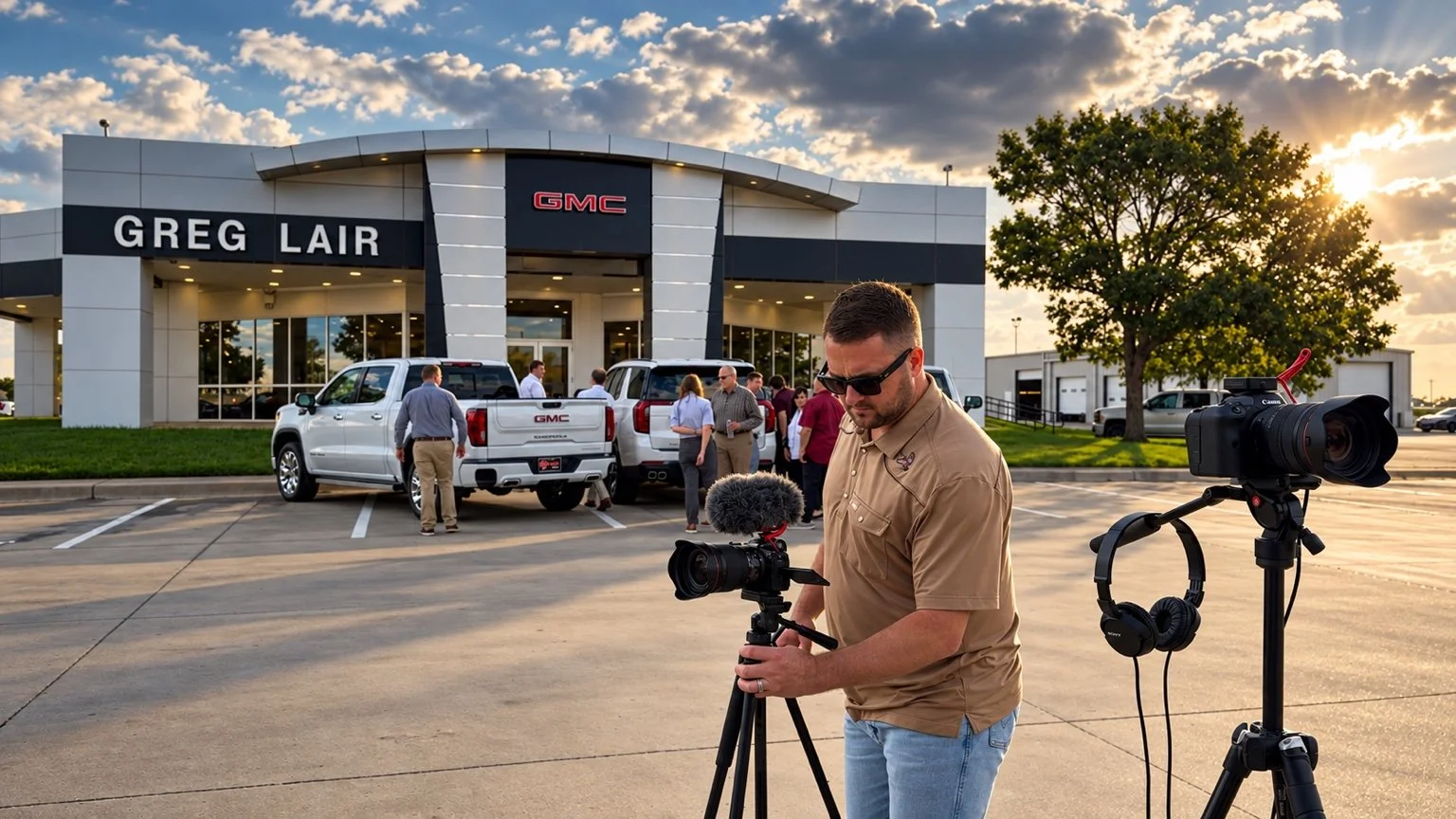
Behind the scenes of a Roosevelt Road Productions shoot at Greg Lair GMC in the Texas Panhandle, with multiple cameras set for a professional commercial video production.
Hiring a video production company can be difficult for one simple reason: almost everybody can show you something that looks good.
Modern cameras are excellent. Editing software is accessible. Drones are everywhere. A thirty-second highlight reel can make almost anyone look capable.
The harder question is whether the company can make your project work.
If you are searching for an Amarillo video production company, the best choice should not come down to who owns the most expensive camera, who has the flashiest website or who gives you the lowest estimate.
You are hiring someone to understand a subject, make creative decisions about it and eventually control how other people see it.
That requires more than equipment.
At Roosevelt Road Productions, I approach filmmaking as a complete storytelling process—from understanding the subject through production, audio, editing and final delivery.
Here is what I would actually look for when deciding who should make your film.
1. Look at Complete Work, Not Just a Highlight Reel
A reel tells you whether someone can collect attractive shots.
A finished film tells you whether they can tell a story.
Those are not the same skill.
When evaluating a video production company, watch at least two or three complete projects. Pay attention to what happens after the beautiful opening shot.
Does the video maintain your attention?
Can you understand what the film is trying to communicate?
Do the interviews feel natural?
Does the music support the story instead of overpowering it?
Does the editing create momentum?
Does the ending feel earned?
Anyone can assemble sixty seconds of their best footage from several years of work. The harder test is whether they can make three, five or thirty minutes hold together when every creative decision matters.
That is one reason I keep years of finished work available through the Roosevelt Road Productions YouTube channel rather than relying exclusively on a short showreel. The channel has grown beyond 10,500 subscribers and includes documentary, western, commercial, automotive, music and original film projects.
Long-form work exposes weaknesses that a reel can hide.
Watch enough of someone’s work to determine whether they can actually hold your attention.
2. Ask What the Video Is Supposed to Accomplish
A production company should be asking questions before recommending cameras, locations or shot lists.
Who needs to see the video?
What do they need to understand?
Where will they watch it?
What should they feel when it ends?
What should they do next?
A website film has a different job than a social advertisement.
A recruitment film is different from a customer testimonial.
A documentary profile is different from a thirty-second commercial.
A ranch film is different from an industrial training video.
The production should be designed around the objective rather than forcing every client into the same format.
I go deeper into those distinctions in Professional Video Production in Amarillo and the Texas Panhandle, including the difference between content creation, commercial production, industrial filmmaking, social video and longer-form storytelling.
For businesses specifically, my video production services in Amarillo page explains how interviews, customer stories, promotional films and shorter platform-specific edits can be developed from the same production when they are planned correctly.
If the first conversation with a production company is entirely about equipment and never about the audience, message or objective, that tells you something.
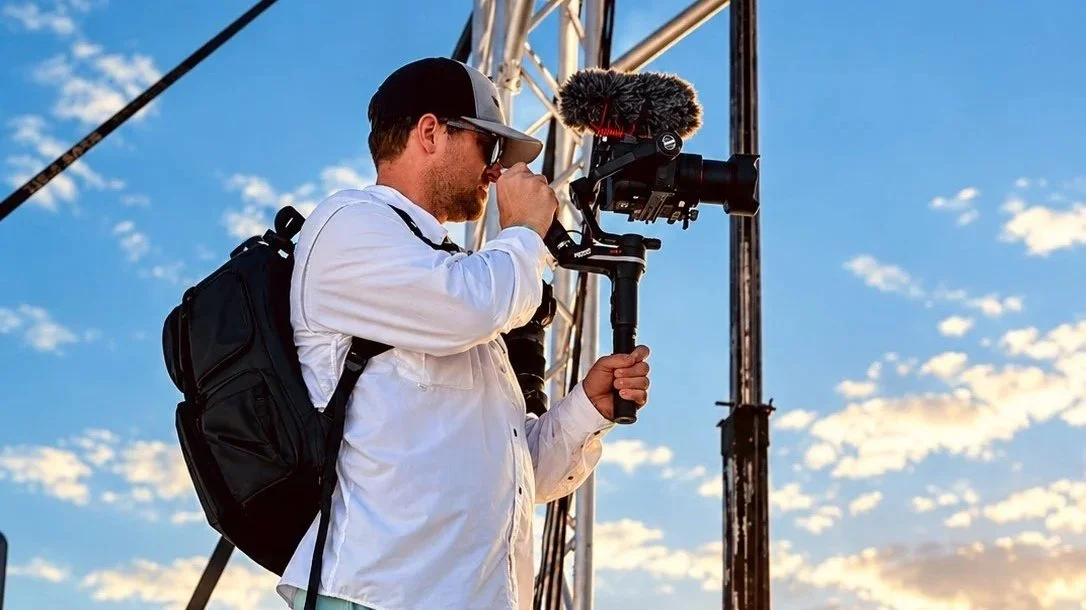
Cole Brakebill films from the stage during a live outdoor event, using a stabilized camera rig to capture professional event footage in changing light and active conditions.
3. Find Out Who Will Actually Be Making Your Film
This matters more than people realize.
Sometimes the person selling the project is not the person directing it.
The director may not be the person shooting it.
The editor may never have been present during production.
None of those arrangements are automatically bad. Larger productions often require specialized crews.
But you should understand the process before hiring anyone.
Who develops the concept?
Who conducts the interviews?
Who operates the camera?
Who edits the finished piece?
Who makes creative decisions if the project changes during production?
And who will you actually communicate with?
Roosevelt Road is an independent production company. Clients work directly with me from the idea through production and the edit.
That continuity is deliberate.
I know why a particular shot was captured because I was there when we decided we needed it. I understand what an interview was supposed to accomplish because I helped develop the questions. Decisions made before production remain connected to decisions made during editing.
Neither a solo filmmaker nor a larger production crew is automatically better.
The important thing is knowing who is actually responsible for your film.
4. Pay Attention to Interviewing Ability
Some of the strongest commercial and documentary films are built around people talking.
That sounds simple until a camera turns on.
People become conscious of their hands.
They shorten answers.
They start using marketing language.
They worry about saying something incorrectly.
A good interviewer knows how to move past that.
The objective usually is not to make someone sound polished. It is to make them sound like themselves while still finding the parts of the conversation that communicate something meaningful.
My approach to interviewing changed substantially while directing and producing In Open Air for Panhandle PBS, a three-part documentary exploring public art throughout Amarillo and the Texas Panhandle.
The complete series can also be watched through the In Open Air episode playlist.
That production required interviews, location filmmaking, narration, archival context and enough structure to carry a story across three full episodes.
I wrote about the process in In Open Air: How This Project Redefined My Creative Limits, and my broader documentary work continues to influence the way I conduct commercial interviews.
A good interviewer knows when to follow an unexpected answer, when to ask the same question differently and when to stop talking long enough for the person on camera to keep going.
If interviews will be central to your project, watch the company’s interview-driven work before hiring them.
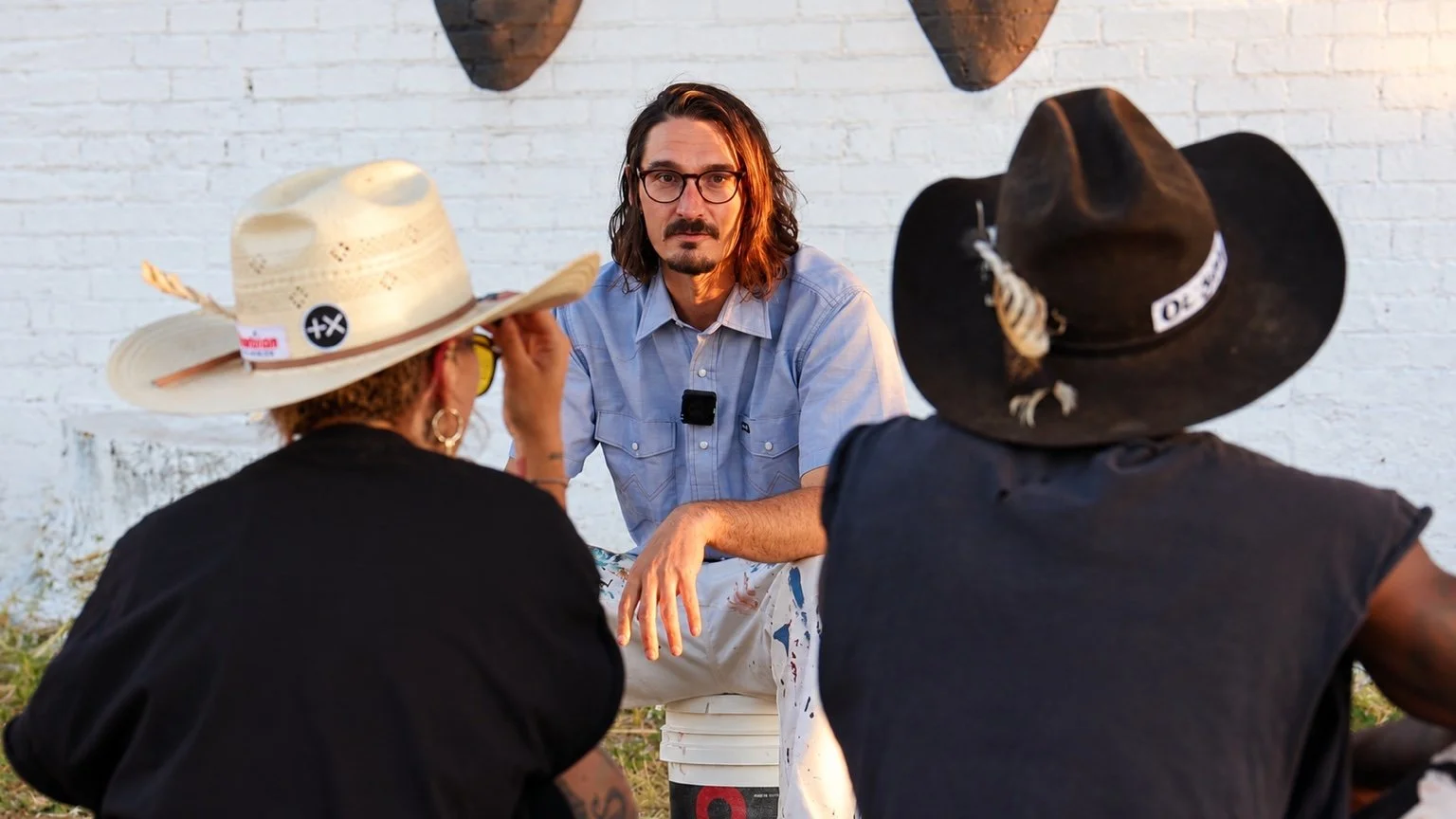
An on-location interview captures a natural conversation in a western setting, illustrating the documentary-style interview approach used in Roosevelt Road Productions projects.
5. Look for Evidence Beyond the Company’s Own Website
Every production company controls what it says about itself.
Independent coverage is different.
A portfolio demonstrates the work.
Third-party coverage establishes that other organizations found the work or filmmaker worth discussing.
My filmmaking was featured by KFDA NewsChannel 10’s Ruben on the Road in a story about Roosevelt Road Productions and my interest in documenting Amarillo and Texas Panhandle stories.
The Eastern New Mexico News later profiled my path into filmmaking, covering my earlier work, projects with world champion rodeo athlete Shad Mayfield, drone cinematography and the development of In Open Air.
The Amarillo Globe-News profiled my filmmaking after my short western film Don’t Bet the Horse You Rode In On received film-festival recognition. The project also has a FilmFreeway listing with its festival and filmmaker information.
More recently, TikiKiti profiled the evolution of my music, filmmaking and storytelling work.
Those features are collected on the Roosevelt Road Press & Recognition page.
Press coverage should not determine who you hire.
But you should look for evidence beyond phrases such as “cinematic,” “professional” or “award-winning.”
Anybody can write those words on a homepage.
6. Do Not Ignore Audio
Audiences will tolerate an imperfect image much longer than they will tolerate bad sound.
Wind noise, room echo, clothing rubbing against microphones, distorted voices and inconsistent levels can make otherwise professional footage unusable.
Ask how the production company approaches audio.
For interview work, that can include wireless microphones, backup recording, controlled levels and monitoring during production.
For location filmmaking, the approach may need to change completely.
This is particularly relevant in the Texas Panhandle.
Wind is not an occasional production problem here.
It is part of the environment.
Filming outdoors around ranches, agriculture, rodeo, construction and remote locations requires planning for conditions rather than pretending they will cooperate.
Audio also does not end when production ends. Dialogue editing, ambient sound, music, silence and dynamics all affect the final film.
My background in music is one reason original music and custom audio are part of Roosevelt Road’s production capabilities rather than something I view as an unrelated service.
7. Local Experience Should Mean More Than Having an Amarillo Address
Knowing the region can be useful, but not because a filmmaker knows where the restaurants are.
The Texas Panhandle creates specific production conditions.
Distance matters.
Wind matters.
Direct sunlight matters.
Weather changes quickly.
Agricultural operations do not stop because a camera crew arrives.
Animals do not hit marks.
Industrial environments have safety requirements.
Rodeo and equine productions move according to the event, not according to the filmmaker’s preferred schedule.
A production company working in Amarillo should be comfortable adapting to those conditions.
It should also understand that this region has its own visual identity.
Western and agricultural subjects do not need to be manufactured into caricatures of the West. The landscape, work, people, animals, machinery, weather and distance already provide the material.
I wrote about that broader sense of place in Amarillo. More Than You Imagined., an essay about the relationship between Amarillo’s western identity, public art, Route 66, Palo Duro Canyon and the less obvious parts of the city.
A filmmaker working here should see more than “Texas scenery.”
The filmmaker’s job is to recognize what makes the place specific.
8. Ask About Pre-Production
A good shoot usually starts before anyone picks up a camera.
Depending on the project, pre-production may include defining the audience and objective, developing the concept, identifying interview subjects, scouting locations, planning audio, determining deliverables, coordinating aerial production and deciding how the footage will eventually be used.
Not every production requires an elaborate treatment and weeks of planning.
Some projects need speed.
Some documentary work benefits from remaining deliberately open.
But the filmmaker should still know what they are trying to capture and why.
My Work With Me process begins with the job the film needs to do and then works backward into the concept, locations, interviews, production requirements and final deliverables.
Showing up with cameras and hoping something interesting happens is not a production strategy.
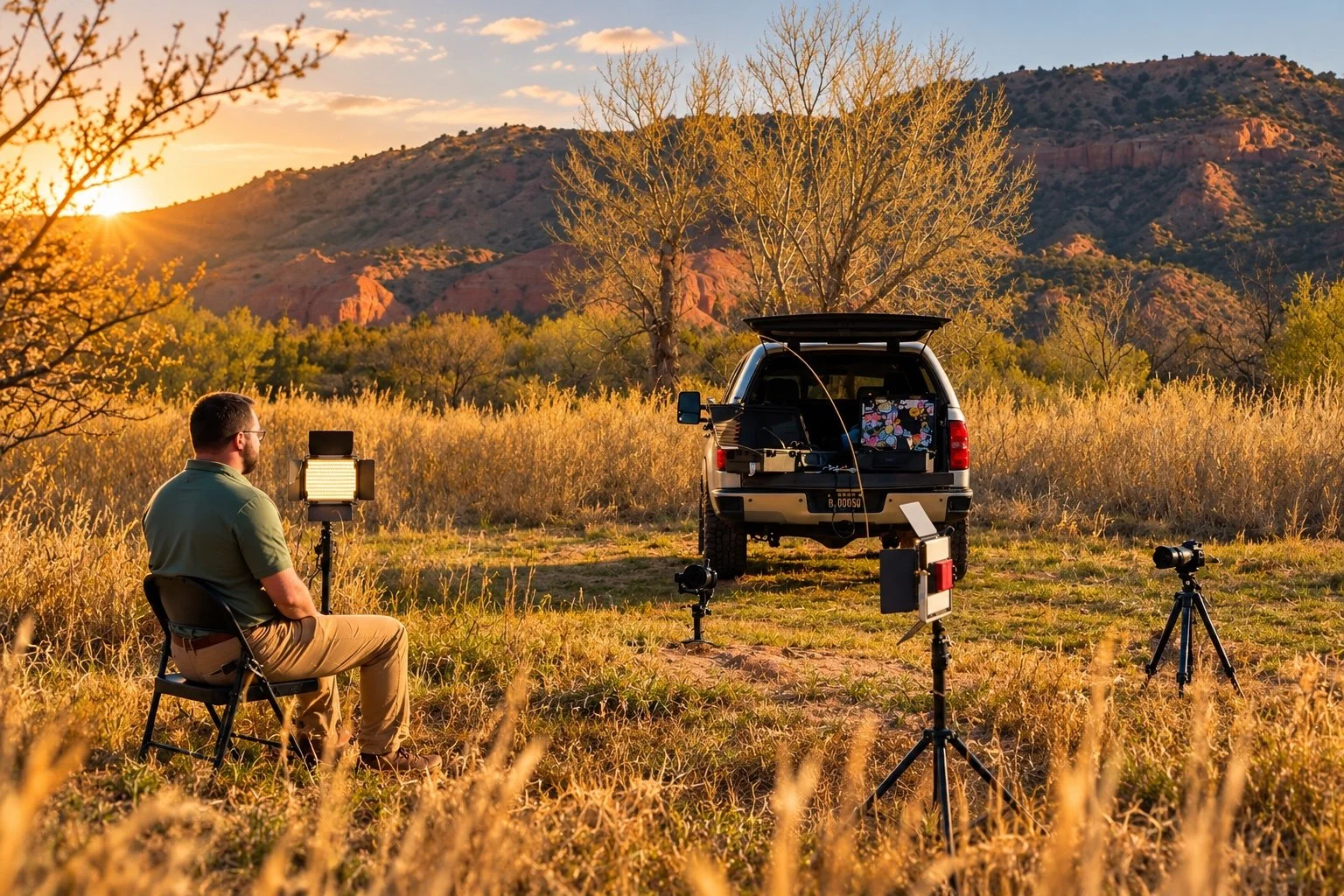
A multi-camera interview production set against the Texas Panhandle landscape at sunset, with professional lighting and camera equipment prepared for an outdoor location shoot.
9. Define the Deliverables Before Production
One of the easiest mistakes to make is discussing “a video” as though that describes the finished product.
It does not.
A project may ultimately need a primary film, thirty-second and fifteen-second edits, vertical content, website footage, interview excerpts, captioned versions, clean versions without graphics or multiple aspect ratios.
Those requirements affect how the original footage should be captured.
A shot composed beautifully for a 16:9 frame may not survive being cropped into 9:16.
An interview framed for a horizontal documentary may leave nowhere for text when adapted for social media.
I discuss that problem more specifically in Professional Video Production in Amarillo and the Texas Panhandle.
One shoot can create a substantial library of material when it is planned correctly.
Trying to manufacture every format afterward is considerably less efficient.
10. Look at Work That Matches Your Actual Environment
A filmmaker may produce excellent restaurant videos and still be the wrong filmmaker for an agricultural operation.
Someone may specialize in weddings and be exceptional at it while having little experience filming manufacturing, livestock, machinery or documentary interviews.
Look for adjacent experience.
One Roosevelt Road production with R&A Welding & Construction combined industrial work, agriculture and a customer interview inside a working feedyard environment.
The story was not simply “look at people welding.”
The customer explains the importance of uptime, the consequences of equipment failure and why the relationship with the contractor matters to the operation.
Western work creates another set of requirements.
My work with Shad Mayfield includes Money $zn and Homegrown, projects that looked beyond the few seconds of competition and toward the person, preparation and life surrounding it. My film work with Wilson Cattle Company centered on the stud horse Tic Tick Boom Boon and the larger story of bloodlines, environment and western culture.
I discuss those projects and the thinking behind them in Amarillo Video Production: What Experience Actually Matters.
If your company operates in a specialized environment, find out whether the filmmaker knows how to recognize what matters inside that environment.
11. Ask About Music, Licensing and Usage Rights
Music changes the emotional meaning of an edit faster than almost anything else.
It is also an area where clients should understand what they are receiving.
Ask where the music comes from.
Is it properly licensed?
Can the video be used in paid advertising?
Are there restrictions on broadcast, streaming or social platforms?
Will the license remain valid?
Does the production include original music when the project calls for it?
Music has been part of my creative work for more than two decades. I wrote about that evolution in More Than 310 Songs: The Most Creative Year of My Life.
That experience affects the way I edit because pacing, tension, silence, transitions and dynamics work together much like arrangement in music.
Original songs, jingles and custom audio can also become part of a project through Roosevelt Road’s original music production when something more specific than a library track is appropriate.
The same rights questions apply to stock footage, photographs, archival material and other third-party assets.
A finished film should not become a licensing problem six months after delivery.
12. If Drone Footage Matters, Ask Why It Is Being Used
Drone footage can be extraordinary.
It can also become visual filler.
An aerial shot should establish something the audience cannot understand as well from the ground: geography, scale, isolation, proximity, movement or the relationship between a subject and the surrounding landscape.
That is particularly valuable in the Texas Panhandle.
Ranches, farmland, facilities, canyons, highways and open country often make considerably more sense from the air.
The Eastern New Mexico News specifically discussed my FAA-certified drone work and aerial filming around Palo Duro Canyon and Amarillo.
But simply owning a drone is not a creative strategy.
Ask what the aerial shot contributes.
If it contributes something, use it.
If it does not, leave it on the ground.
13. Do Not Hire Based on Equipment Alone
Professional equipment matters.
There is a minimum technical standard that commercial work should meet.
But cameras are tools.
A filmmaker still has to decide where to put one.
They have to recognize good light.
They have to understand composition.
They have to anticipate movement.
They have to know when a moment is about to happen.
They have to recognize the strongest sentence in a forty-minute interview.
Eventually they have to decide what stays in the film and what gets removed.
A camera cannot make those decisions.
That idea is central to Amarillo Video Production: What Experience Actually Matters.
It also shows up somewhere less obvious in my work. In Chevrolet FlatLander: I’m Not Building a Custom Truck, I’m Editing One, I wrote about realizing that filmmaking, songwriting, painting and vehicle design all depend on a similar discipline: deciding what belongs and removing what does not.
When evaluating an Amarillo video production company, equipment should confirm that the company is technically capable.
It should not be the primary reason you hire them.
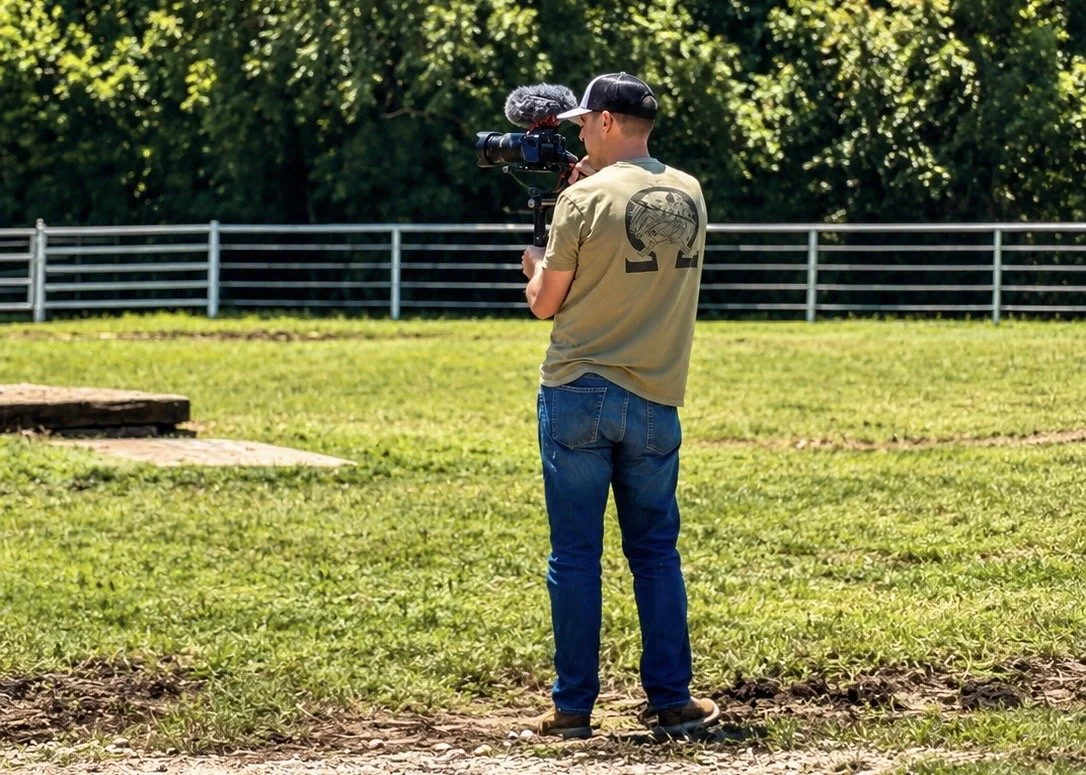
Roosevelt Road Productions filming on location in a rural setting, using a handheld stabilized camera setup for documentary, agricultural and western-style production work.
14. Price Matters, but Scope Matters First
Video production quotes can vary dramatically because the phrase “video production” can describe dramatically different jobs.
One project may require a single location, one interview and a half-day shoot.
Another may involve multiple locations, scripting, lighting, aerial footage, several interviews, original music, extensive post-production and multiple final versions.
Those projects should not cost the same.
Before comparing prices, compare scope.
How much filming is included?
How many locations?
How many finished videos?
How much editing?
Are revisions included?
Is travel included?
Are graphics included?
Is drone work included?
What music rights are included?
Are vertical versions separate deliverables?
The Roosevelt Road project-planning information explains why production cost follows scope rather than a generic price attached to the word “video.”
A cheaper proposal is not actually cheaper if it leaves out half of what the project requires.
15. Look for Range Without Losing Point of View
Versatility matters.
A filmmaker should be able to adjust when the subject changes.
A documentary should not look exactly like an advertisement.
A rodeo film should not feel like a corporate interview.
A music video should not feel like an industrial profile.
At the same time, there should be evidence of a point of view.
That is another reason I maintain a substantial body of finished work through the Roosevelt Road Productions YouTube channel and a broader archive through the Roosevelt Road blog.
Look through the work and ask:
Does this company seem curious about the people it films?
Can it recognize meaningful details?
Does the work feel observational when it needs to?
Can it become polished and controlled when the project requires it?
Technical consistency is important.
Creative sameness is not.
16. Make Sure the Company Understands the Subject Before Trying to Make It Look Impressive
This may be the most important consideration.
Video production is representation.
If you own a company, the filmmaker is representing something you may have spent decades building.
If you operate a ranch, the film is representing your land, animals, family and work.
If you are an artist, the film becomes part of how people interpret what you create.
If the subject is history or documentary work, the responsibility becomes even greater.
The filmmaker should be interested enough to understand the subject before deciding how to present it.
Good production does not begin with:
How can we make this look cinematic?
It begins with:
What is actually interesting here?
Once you know the answer, the cinematography has something to serve.
Questions to Ask an Amarillo Video Production Company Before Hiring Them
Before choosing a production company, ask:
Who will actually direct, shoot and edit my project?
Can I watch complete examples of similar work?
How do you approach pre-production?
How do you handle interviews?
How do you record and monitor professional audio?
What deliverables are included?
Can the production be planned for both horizontal and vertical use?
How are music and other media licensed?
What is included in the quoted price?
How are revisions handled?
Have you worked in environments similar to mine?
What do you think the story or central idea of this project actually is?
The final question may tell you more than the other eleven.
A good filmmaker should have an answer.
Hiring Video Production in Amarillo, Texas
There are talented filmmakers and production companies in Amarillo.
That is good for anyone hiring video production here.
You do not need to choose a company because it claims to be the best.
Look at the work.
Ask how they think.
Find out who will actually make the film.
Look at what independent organizations have said about the work.
Understand what you are buying.
Then choose the filmmaker whose approach fits the subject.
I’m Cole Brakebill, Creative Director of Roosevelt Road Productions in Amarillo, Texas. My work includes western and agricultural films, documentaries, rodeo and equine stories, business and brand films, artist films, music videos, aerial cinematography, interviews, editing and original music.
My filmmaking has included work with world champion athletes, agricultural and industrial businesses, independent narrative films and the three-part In Open Air documentary series for Panhandle PBS. My work has also been covered by KFDA NewsChannel 10, Eastern New Mexico News, the Amarillo Globe-News and TikiKiti.
You can explore video production services in Amarillo, see my documentary work, browse the Roosevelt Road Productions blog, review additional press and recognition, watch finished work on YouTube or start a conversation about your project.
The approach starts in the same place:
Find what matters before deciding how to film it.
Cole Brakebill
Creative Director
Roosevelt Road Productions
Amarillo, Texas
806-316-7182
RooseveltRoadLLC@gmail.com